
Welcome to the ASL Program

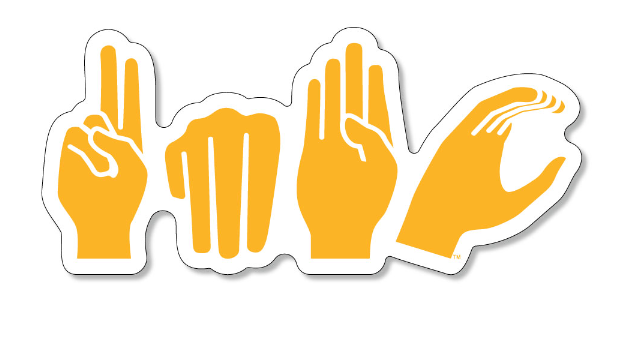
A graphic image of four hands that signs the letters U, M, B, and C.American Sign Language (ASL) is a visual language that uses hand, facial, and body movements to communicate. Sign language promotes communication with the Deaf community and provides an accessible language for Deaf and Hard-of-Hearing individuals from birth. Learning ASL can enhance cognitive skills, strengthen the connection between the body and mind, and support more effective communication. It is also the sixth most commonly used language in the United States.

When taken at the 201-level, ASL will fulfill UMBC’s General Education Program (GEP) Foreign Language requirement. ASL Courses are offered every semester: Fall, Winter, Spring, and Summer.

ASL Course Descriptions

American Sign Language 101 is designed for students who have little or no previous knowledge of ASL. The course emphasizes simple receptive and expressive conversational skills and the unique features of American Sign Language grammar. Readiness for learning will be approached via visual-gestural communication techniques, visual discrimination, and visual memory exercises, emphasizing the acquisition of comprehension, production, and interactional skills using basic grammatical features. ASL will be taught within contexts and related to general surroundings and everyday life experiences. The course also provides a historical overview of American Sign Language and an introduction to deaf culture and folklore. Videos, films, readings and non-verbal feedback exercises will be a part of the instruction using tools.

Prerequisite: ASL101 with a “C” or better.

American Sign Language 102 is designed to build on ASL 101 providing for a higher level of receptive and conversational practice and will introduce several “uninterpreted” activities. Learning goals will focus on the development of American Sign Language (ASL) skills with a primary focus on refining the use of basic ASL sentence types. Pronominalization, classifiers, spatial referencing, pluralization, and temporal and distributional aspects are introduced. Students will learn routine communicative functions of the language: asking, requesting, providing clarification, giving and asking for directions. Information about the Deaf Community and Deaf Culture will be included.

Meets GEP Language Requirement.
Prerequisite: ASL102 with a “C” or better.

American Sign Language 201 is designed to build on ASL 102 in order to further develop the receptive and expressive visual communication skills in ASL. This will include adding more complex ASL grammatical features and vocabulary, short stories, narratives, and dialogues. The course will include a description of general surroundings, appropriate sequencing, temporal aspects, and conditionals. The course will also focus on cultural aspects of the deaf community and will include discussions and formal signing presentations.

Have ASL Experience??
If you have already taken ASL and/or already know how to sign, please contact the ASL Coordinator, Tim Olivella (timolive@umbc.edu), to inquire about placement options and/or proficiency testing opportunities.